
Original Research Articles
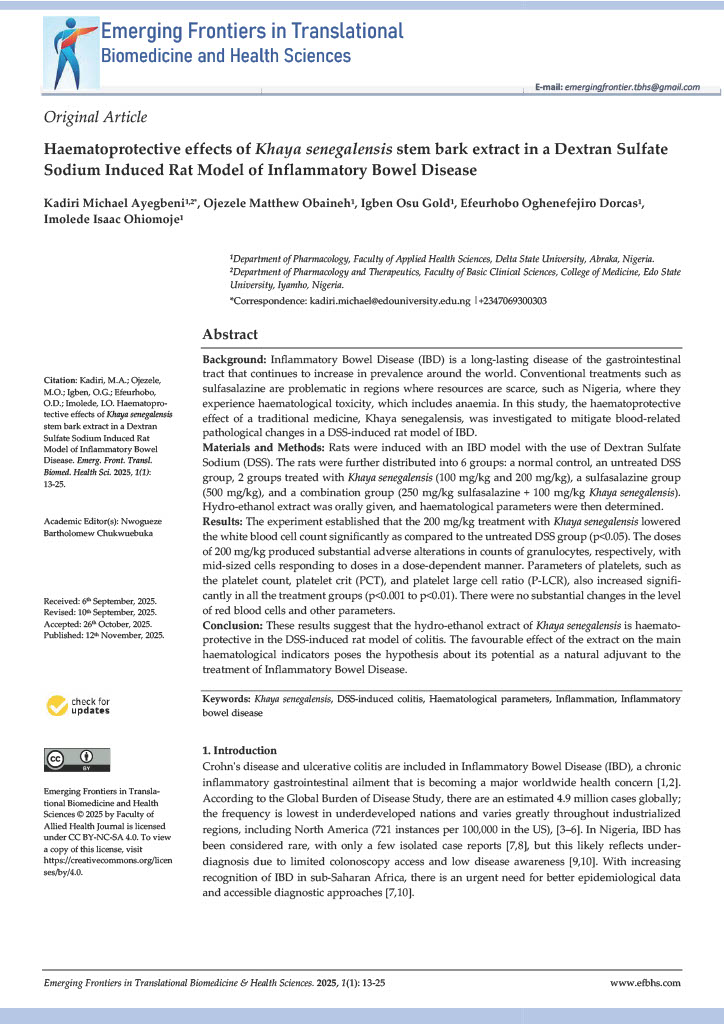
Haematoprotective Effects of Khaya Senegalensis Stem Bark Extract in a Dextran Sulphate Sodium Induced Rat Model of Inflammatory Bowel Disease
- Authors
- Keywords:
- Khaya senegalensis, DSS-induced colitis, Haematological parameters, Inflammation,, Inflammatory bowel disease
- Abstract
-
Background: Inflammatory Bowel Disease (IBD) is a long-lasting disease of the gastrointestinal tract that continues to increase in prevalence around the world. Conventional treatments such as sulfasalazine are problematic in regions where resources are scarce, such as Nigeria, where they experience haematological toxicity, which includes anaemia. In this study, the haematoprotective effect of a traditional medicine, Khaya senegalensis, was investigated to mitigate blood-related pathological changes in a DSS-induced rat model of IBD.
Materials and Methods: Rats were induced with an IBD model with the use of Dextran sulphate Sodium (DSS). The rats were further distributed into 6 groups: a normal control, an untreated DSS group, 2 groups treated with Khaya senegalensis (100 mg/kg and 200 mg/kg), a sulfasalazine group (500 mg/kg), and a combination group (250 mg/kg sulfasalazine + 100 mg/kg Khaya senegalensis). Hydro-ethanol extract was orally given, and haematological parameters were then determined.
Results: The experiment established that the 200 mg/kg treatment with Khaya senegalensis lowered the white blood cell count significantly as compared to the untreated DSS group (p<0.05). The doses of 200 mg/kg produced substantial adverse alterations in counts of granulocytes, respectively, with mid-sized cells responding to doses in a dose-dependent manner. Parameters of platelets, such as the platelet count, platelet crit (PCT), and platelet large cell ratio (P-LCR), also increased significantly in all the treatment groups (p<0.001 to p<0.01). There were no substantial changes in the level of red blood cells and other parameters.
Conclusion: These results suggest that the hydro-ethanol extract of Khaya senegalensis is haematoprotective in the DSS-induced rat model of colitis. The favourable effect of the extract on the main haematological indicators poses the hypothesis about its potential as a natural adjuvant to the treatment of Inflammatory Bowel Disease.
- References
-
1. Alatab S, Sepanlou SG, Ikuta K, Vahedi H, Bisignano C, Safiri S, Sadeghi A, Nixon MR, Abdoli A, Abolhassani H, Alipour V, Almadi MAH, Almasi-Hashiani A, Anushiravani A, Arabloo J, Atique S, Awasthi A, Badawi A, Baig AA, Bhala N, Bijani A, Biondi A, Borzì AM, Burke KE, Carvalho F, Daryani A, Dubey M, Eftekhari A, Fernandes E, Fernandes JC, Fischer F, Haj-Mirzaian A, Haj-Mirzaian A, Hasanzadeh A, Hashemian M, Hay SI, Hoang CL, Househ M, Ilesanmi OS, Balalami NJ, James SL, Kengne AP, Malekzadeh MM, Merat S, Meretoja TJ, Mestrovic T, Mirrakhimov EM, Mirzaei H, Mohammad KA, Mokdad AH, Monasta L, Negoi I, Nguyen TH, Nguyen CT, Pour-shams A, Poustchi H, Rabiee M, Rabiee N, Ramezanzadeh K, Rawaf DL, Rawaf S, Rezaei N, Robinson SR, Ronfani L, Saxena S, Sepehrimanesh M, Shaikh MA, Sharafi Z, Sharif M, Siabani S, Sima AR, Singh JA, Soheili A, Sotou-dehmanesh R, Suleria HAR, Tesfay BE, Tran B, Tsoi D, Vacante M, Wondmieneh AB, Zarghi A, Zhang Z, Dirac M, Malekzadeh R, Naghavi M. The global, regional, and national burden of inflammatory bowel disease in 195 countries and territories, 1990-2017: a systematic analysis for the global burden of disease study 2017. Lancet Gastroenterol Hepatol. 2020;5(1):17-30. DOI: https://doi.org/10.1016/S2468-1253(19)30333-4
2. Kaplan GG. The global burden of inflammatory bowel disease: from 2025 to 2045. Nat Rev Gastroenterol Hepatol. 2025:1-13. doi:10.1038/s41575-025-01097-1 DOI: https://doi.org/10.1038/s41575-025-01097-1
3. Hracs L, Windsor JW, Gorospe J, Cummings M, Coward S, Buie MJ, Quan J, Goddard Q, Caplan L, Markovinović A, Williamson T, Abbey Y, Abdullah M, Abreu MT, Ahuja V, Raja Ali RA, Altuwaijri M, Balderramo D, Banerjee R, Benchimol EI, Bernstein CN, Brunet-Mas E, Burisch J, Chong VH, Dotan I, Dutta U, El Ouali S, Forbes A, Forss A, Gearry R, Dao VH, Hartono JL, Hilmi I, Hodges P, Jones GR, Juliao-Baños F, Kaibullayeva J, Kelly P, Kobayashi T, Kotze PG, Lakatos PL, Lees CW, Limsrivilai J, Lo B, Loftus EV Jr, Ludvigsson JF, Mak JWY, Miao Y, Ng KK, Oka-bayashi S, Olén O, Panaccione R, Paudel MS, Quaresma AB, Rubin DT, Simadibrata M, Sun Y, Suzuki H, Toro M, Turner D, Iade B, Wei SC, Yamamoto-Furusho JK, Yang SK, Ng SC, Kaplan GG; Global IBD Visualization of Epi-demiology Studies in the 21st Century (GIVES-21) Research Group. Global evolution of inflammatory bowel disease across epidemiologic stages. Nature. 2025; 642(8067):458-466. DOI: https://doi.org/10.1038/s41586-025-08940-0
4. Wang R, Li Z, Liu S, Zhang D. Global, regional and national burden of inflammatory bowel disease in 204 countries and territories from 1990 to 2019: a systematic analysis. BMJ Open. 2023;13:e065186. doi:10.1136/bmjopen-2022-065186 DOI: https://doi.org/10.1136/bmjopen-2022-065186
5. Kaplan GG, Windsor JW. The four epidemiological stages in the global evolution of inflammatory bowel disease. Nat Rev Gastroenterol Hepatol. 2021; 18(1):56-66. DOI: https://doi.org/10.1038/s41575-020-00360-x
6. Kaplan G, Hracs L, Windsor J, Gorospe J, Cummings M, Coward S. The global evolution of inflammatory bowel disease across four epidemiologic stages: analysis based on the Global Burden of Disease Study 2019. BMJ Open. 2024; 13(3):e065186. doi:10.21203/rs.3.rs-3846147/v1 DOI: https://doi.org/10.21203/rs.3.rs-3846147/v1
7. Musa Y, Saleh HT, Onyia CP, Aminu AS, Okonkwo KC, Adeniyi OF, Olaitan AL, Zubairu HA, Dankiri NA, Manko M, Bojuwoye MO, Olubukola OO, Odeghe E, Umar YS, Oyeleke GK, Mustapha I, Nwoko CU, Chukwudike ES.. Unmasking inflammatory bowel disease in Nigeria: a multicenter cross-sectional analysis of clinico-pathological and endoscopic findings. J Transl Gastroenterol. 2025; (000):0-0. doi:10.14218/JTG.2025.00011 DOI: https://doi.org/10.14218/JTG.2025.00011
8. Ukwenya AY, Ahmed A, Odigie VI, Mohammed A. Inflammatory bowel disease in Nigerians: still a rare diagnosis? Ann Afr Med. 2011; 10(2):175-179. doi:10.4103/1596-3519.82067 DOI: https://doi.org/10.4103/1596-3519.82067
9. Watermeyer G, Katsidzira L, Setshedi M, Devani S, Mudombi W, Kassianides C. Inflammatory bowel disease in sub-saharan africa: epidemiology, risk factors, and challenges in diagnosis. Lancet Gastroenterol Hepatol. 2022; 7(10): 952-961. DOI: https://doi.org/10.1016/S2468-1253(22)00047-4
10. Ng SC, Shi HY, Hamidi N, Underwood FE, Tang W, Benchimol EI, Panaccione R, Ghosh S, Wu JCY, Chan FKL, Sung JJY, Kaplan GG. Worldwide incidence and prevalence of inflammatory bowel disease in the 21st century: a systematic review of population-based studies. Lancet. 2017; 390(10114):2769-2778. DOI: https://doi.org/10.1016/S0140-6736(17)32448-0
11. Nóbrega VG, Silva INDN, Brito BS, Silva J, Silva MCMd, Santana GO. The onset of clinical manifestations in in-flammatory bowel disease patients. Arq Gastroenterol. 2018; 55(3):290-295. DOI: https://doi.org/10.1590/s0004-2803.201800000-73
12. Fields JM, Dean AJ. Systemic causes of abdominal pain. Emerg Med Clin North Am. 2011;29(2):195-210. DOI: https://doi.org/10.1016/j.emc.2011.01.011
13. Deshmukh CD. A review on inflammatory bowel disease. Asian J Pharm Clin Res. 2023; 16(6):11-14. DOI: https://doi.org/10.22159/ajpcr.2023.v16i6.47124
14. Diez-Martin E, Hernandez-Suarez L, Muñoz-Villafranca C, Martin-Souto L, Astigarraga E, Ramirez-Garcia A, Barreda-Gómez G. Inflammatory bowel disease: a comprehensive analysis of molecular bases, predictive bio-markers, diagnostic methods, and therapeutic options. Int J Mol Sci. 2024; 25(13):7062. DOI: https://doi.org/10.3390/ijms25137062
15. Rogler G, Vavricka S. Anaemia in inflammatory bowel disease: an under-estimated problem? Front Med. 2015; 1:58. doi:10.3389/fmed.2015.00058 DOI: https://doi.org/10.3389/fmed.2014.00058
16. Kaitha S, Bashir M, Ali T. Iron deficiency anaemia in inflammatory bowel disease. World J Gastrointest Pathophysiol. 2015; 6(3):62. DOI: https://doi.org/10.4291/wjgp.v6.i3.62
17. Gasche C, Lomer MCE, Cavill I, Weiss G. Iron, anaemia, and inflammatory bowel diseases. Gut. 2004; 53(8):1190-1197. DOI: https://doi.org/10.1136/gut.2003.035758
18. Means RT Jr, Weber KT. Hepcidin and iron regulation in health and disease. Am J Med Sci. 2013; 345(1):57-60. DOI: https://doi.org/10.1097/MAJ.0b013e318253caf1
19. Ali Sohrabpour A, Malekzadeh R, Keshavarzian A. Current therapeutic approaches in inflammatory bowel dis-ease. Curr Pharm Des. 2010; 16(33):3668-3683. DOI: https://doi.org/10.2174/138161210794079155
20. Peppercorn MA. Sulfasalazine: pharmacology, clinical use, toxicity, and related new drug development. Ann In-tern Med. 1984; 101(3):377-386. DOI: https://doi.org/10.7326/0003-4819-101-3-377
21. Lee KR, Gulnaz A, Chae YJ. Drug interaction-informed approaches to inflammatory bowel disease management. Pharmaceutics. 2024; 16(11):1431. DOI: https://doi.org/10.3390/pharmaceutics16111431
22. Sankar V, Villa A. Hematologic diseases. In: Burket's oral medicine. 2021. p.627-664. doi:10.1002/9781119597797.ch17 DOI: https://doi.org/10.1002/9781119597797.ch17
23. Chettri N, Mamadapur M, Subramanian R, Sandhya D, BR JK. Sulfasalazine-induced agranulocytosis: a case series and review of literature. Mediterr J Rheumatol. 2024; 35(3):479. DOI: https://doi.org/10.31138/mjr.010124.sia
24. Adamu I, Majiyebo AJ, Alozieuwa UB, Lawal AA, Alawode BOORA, Berinyuy EB. Ethnopharmacology, chemical constituents, and biological activities of khaya senegalensis (desr) a juss: a forest plant with multi-purpose applications. AROC Nat Prod Res. 2022; 2(2):10-15. DOI: https://doi.org/10.53858/arocnpr02021015
25. Olatunji TL, Odebunmi CA, Adetunji AE. Biological activities of limonoids in the genus khaya (meliaceae): a re-view. Fut J Pharm Sci. 2021; 7(1):74. DOI: https://doi.org/10.1186/s43094-021-00197-4
26. Mohammed Y. Evaluation of the anticancer potentials of Senna alata leaf and Khaya senegalensis stem bark ex-tracts on colorectal cancer cell line. Doctoral dissertation. 2023.
27. Tyoapine DA, Victory PC, Yusuf A, Badamasi AM. A review of the phytochemistry and pharmacology of Khaya senegalensis (Desr) A Juss. IJRPR. 2022; (2582):7421.
28. Oseyomon JO, Erhirhie EO, Ugwu CB, Ilodigwe EE. Toxicological evaluation of methanol extract of hunteriaumbellata seed on sperm and haematological parameters in male wistar rats. J Appl Sci Environ Manage. 2023; 27(11):2487-2493. DOI: https://doi.org/10.4314/jasem.v27i11.18
29. Kim SY, Kim HJ, Hwang SK, Park KS. Potential phytotherapy of DSS-induced colitis: ameliorating reactive oxygen species-mediated necroptosis and gut dysbiosis with a new Crataegus pinnatifida Bunge variety—Daehong. An-tioxidants (Basel). 2024; 13(3):340. doi:10.3390/antiox13030340
30. Lee KI, Jo Y, Yuk HJ, Kim SY, Kim H, Kim HJ, Hwang SK, Park KS. Potential phytotherapy of DSS-induced colitis: ameliorating reactive oxygen species-mediated necroptosis and gut dysbiosis with a new Crataegus pinnatifida Bunge variety—Daehong. Antioxidants (Basel). 2024; 13(3):340. doi:10.3390/antiox13030340 DOI: https://doi.org/10.3390/antiox13030340
31. Chassaing B, Aitken JD, Malleshappa M, Vijay-Kumar M. Dextran sulfate sodium (dss)-induced colitis in mice. CurrProtoc Immunol. 2014; 104(1):15-25. DOI: https://doi.org/10.1002/0471142735.im1525s104
32. Shen J, Ma X, He Y, Wang Y, Zhong T, Zhang Y. Anti-inflammatory and anti-oxidant properties of Melianodiol on DSS-induced ulcerative colitis in mice. PeerJ. 2022; 10:e14209. doi:10.7717/peerj.14209 DOI: https://doi.org/10.7717/peerj.14209
33. Kulnigg-Dabsch S, Evstatiev R, Dejaco C, Gasche C. Effect of iron therapy on platelet counts in patients with in-flammatory bowel disease-associated anemia. PLoS One. 2012; 7(4):e34520. doi:10.1371/journal.pone.0034520 DOI: https://doi.org/10.1371/journal.pone.0034520
34. Loveikyte R, Boer M, van der Meulen CN, Ter Steege RWF, Tack G, Kuyvenhoven J, Jharap B, Vu MK, Vogelaar L, West RL, van der Marel S, Römkens TEH, Mujagic Z, Hoentjen F, van Bodegraven AA, van Schaik FDM, de Vries AC, Dijkstra G, van der Meulen-de Jong AE. Anemia and iron deficiency in outpatients with inflammatory bowel disease: ubiquitous yet suboptimally managed. J Clin Med. 2022; 11(22):6843. DOI: https://doi.org/10.3390/jcm11226843
35. Chinnadurai GS, Krishnan S, Perumal P. Studies on detection and analysis of proteases in leaf extract of medici-nally important plants. Phytomedicine. 2018; 40:176-188. doi:10.1016/j.phymed.2018.01.011 DOI: https://doi.org/10.1016/j.phymed.2018.01.011
36. Danese S, De La Motte C, Fiocchi C. Platelets in inflammatory bowel disease: clinical, pathogenic, and therapeutic implications. Am J Gastroenterol. 2004; 99(5):938-945. DOI: https://doi.org/10.1111/j.1572-0241.2004.04129.x
37. Semikina EL, Tsvetkova VS, Potapov AS, Fisenko AP, Kopyl'tsova EA, Akulova SS, Surkov AN, Lokhmatov MM, Budkina TN, Vershinina MG. Diagnostic value of platelet count and platelet indices in assessing inflammatory bowel disease activity in children. PediatrNutr. 2021; 19:26. DOI: https://doi.org/10.20953/1727-5784-2021-3-26-36
38. Kurec A. Platelet indices–underappreciated diagnostic/prognostic tool. Breast Cancer. 2023;19:63.
39. Zhou MM, Zhang WY, Li RJ, Guo C, Wei SS, Tian XM, Luo J, Kong LY. Anti-inflammatory activity of Khayandi-robilide A from Khaya senegalensis via NF-kB, AP-1 and p38 MAPK/Nrf2/HO-1 signaling pathways in LPS-stimulated RAW 264.7 and BV-2 cells. Phytomedicine. 2018;42:152-163. doi:10.1016/j.phymed.2017.12.017 DOI: https://doi.org/10.1016/j.phymed.2018.03.016
40. Dougnon V, Hounsa E, Koudokpon H, Legba BB, Fabiyi K, Sintondji K, Afaton A, Akouta M, Klotoe J, Bankole H, Baba-Moussa L, Dougnon JA, Akouta AM, Klotoe J, Bankole H, Baba-Moussa L, Dougnon J. A literature re-view—khaya senegalensis, anacardium ouest l., cassia sieberiana dc., pterocarpus erinaceus, diospyros mespili-formis, ocimumgratissimum, manihot esculenta, vernonia amygdalina, pseudocedrelakotschyi and danielliaoliveri possess properties for managing infectious diarrhea. Adv BiosciBiotechnol. 2020; 11(10):457-473. DOI: https://doi.org/10.4236/abb.2020.1110031
41. Malesza IJ, Bartkowiak-Wieczorek J, Winkler-Galicki J, Nowicka A, Dzięciołowska D, Błaszczyk M, Gajniak P, Słowińska K, Niepolski L, Walkowiak J, Mądry E. The dark side of iron: the relationship between iron, inflammation and gut microbiota in selected diseases associated with iron deficiency anaemia—a narrative review. Nutrients. 2022; 14(17):3478. DOI: https://doi.org/10.3390/nu14173478
42. Montoro-Huguet MA, Belloc B, Domínguez-Cajal M. Small and large intestine (i): malabsorption of nutrients. Nutrients. 2021; 13(4):1254. DOI: https://doi.org/10.3390/nu13041254
43. Samba-Mondonga M, Constante M, Fragoso G, Calvé A, Santos MM. Curcumin induces mild anemia in a DSS-induced colitis mouse model maintained on an iron-sufficient diet. PLoS One. 2019; 14(4):e0208677.doi:10.1371/journal.pone. 0208677 DOI: https://doi.org/10.1371/journal.pone.0208677
44. Marius L, Kini FÃ, Pierre D, Pierre GI. In vitro antioxidant activity and phenolic contents of different fractions of ethanolic extract from khaya senegalensis a juss (meliaceae) stem barks. Afr J Pharm Pharmacol. 2016; 10(23):501-507. DOI: https://doi.org/10.5897/AJPP2016.4564
45. Heer SK, Falana AB, Adie MA, Adeleke AA, Edeani JF, Falobi AA, Constance CO, Iyiola OT, Opeolu OO. Protective effects of Khaya senegalensis stem bark extracts against acetaminophen-induced oxidative damage, dyslipi-daemia, and hepatotoxicity in rats. F1000Res. 2024; 13:1129. doi:10.12688/f1000research.156123.1 DOI: https://doi.org/10.12688/f1000research.156123.1
46. Ross DM. How much imatinib is enough? Br J Haematol. 2021; 193(4). doi:10.1111/bjh.17444 DOI: https://doi.org/10.1111/bjh.17444
47. Chen H, Li Y, Wang J, Zheng T, Wu C, Cui M, Feng Y, Ye H, Dong Z, Dang Y. Plant polyphenols attenuate dss-induced ulcerative colitis in mice via antioxidation, anti-inflammation and microbiota regulation. Int J Mol Sci. 2023; 24(13):10828. DOI: https://doi.org/10.3390/ijms241310828
48. Singh A, Bisht P, Bhattacharya S, Guchhait P. Role of platelet cytokines in dengue virus infection. Front Cell Infect Microbiol. 2020; 10:561366. doi:10.3389/fcimb.2020.561366 DOI: https://doi.org/10.3389/fcimb.2020.561366
49. Ransford RAJ, Langman MJS. Sulphasalazine and mesalazine: serious adverse reactions re-evaluated on the basis of suspected adverse reaction reports to the committee on safety of medicines. Gut. 2002; 51(4):536-539. DOI: https://doi.org/10.1136/gut.51.4.536
50. Li T, Qian Y, Bai T, Li J. Prediction of complications in inflammatory bowel disease using routine blood parameters at diagnosis. Ann Transl Med. 2022; 10(4):185. DOI: https://doi.org/10.21037/atm-22-123
51. Gupta A. Iron deficiency anemia. In: Decision making through problem based learning in hematology: a step-by-step approach in patients with anemia. Singapore: Springer Nature Singapore; 2024. p.1-16. doi:10.1007/978-981-99-8933-1 DOI: https://doi.org/10.1007/978-981-99-8933-1_1
52. Simeon CA, Beega GF, Abiola SA, Wofuru CD, Eze CC. Significance of inflammatory biomarkers in clinical diagnostics: ESR versus other inflammatory biomarkers—a review. Int J Sci Res Arch. 2024; 12:1980-1995. doi:10.30574/ijsra. 2024.12.2.1469
- Cover Image
-
- Downloads
- Published
- 12-11-2025 — Updated on 12-11-2025
- Versions
-
- 12-11-2025 (2)
- 12-11-2025 (1)
- Section
- Original Research Articles
-
Give appropriate credit to the original author(s) and the journal.
-
Provide a link to the license.
-
Indicate if changes were made.
-
Distribute their contributions under the same license as the original.
-
Share — copy and redistribute the material in any medium or format.
-
Adapt — remix, transform, and build upon the material.
-
Attribution required — must credit author(s) and journal.
-
NonCommercial — no commercial use permitted.
-
ShareAlike — derivative works must use the same license.
License

This work is licensed under a Creative Commons Attribution-NonCommercial-ShareAlike 4.0 International License.
Copyright (c) 2025 Emerging Frontiers in Translational Biomedicine and Health Sciences
All content published in Emerging Frontiers in Translational Biomedicine and Health Sciences (EFTBHS) is licensed under a Creative Commons Attribution–NonCommercial–ShareAlike 4.0 International License (CC BY-NC-SA 4.0).
This license allows others to remix, adapt, and build upon the work non-commercially, as long as they:
Under this license, users may not use the material for commercial purposes.
Authors retain copyright and grant the journal the right of first publication. Authors may enter into separate, non-exclusive agreements for non-commercial distribution (e.g., in institutional repositories or course materials) with acknowledgment of the initial publication in EFTBHS.
For details, visit the official Creative Commons page:
https://creativecommons.org/licenses/by-nc-sa/4.0/
Summary of permissions under CC BY-NC-SA 4.0:
Most read articles by the same author(s)
- Isibor Nkechi Precious, Moke Emuesiri Goodies, Umukoro Emuesiri Kohworho, Ben-Azu Benneth, Kadiri Michael Ayegbeni, Elijah Oghenekparobor Blessing, Ekuerhare Basil, Isidahomen Oritsesholayemi Faith, Collaborative Impact of Diabetes Education by International Diabetes Federation and National Health Systems on Prevalence of Diabetes Amongst the Indigenous People of Africa , Emerging Frontiers in Translational Biomedicine and Health Sciences: Vol. 1 No. 1 (2025): Translational Frontiers in Biomedicine and Health
- Akinyele Olubiyi Akinsola, Matthew Obaineh Ojezele, Anthony Taghogho Eduviere, Celestine Ogheneruro Akpovwre, Hematological and Biochemical Evaluation of Acute and Sub-acute Oral Toxicity of Azanza garckeana Hydroethanolic Fruit Extract in Male Wistar Rats , Emerging Frontiers in Translational Biomedicine and Health Sciences: Vol. 1 No. 2 (2025): Bridging research and clinical practice
Similar Articles
- Happy Isibor, Anthony Taghogho Eduviere, Benneth Ben-Azu, Celestine Ogheneruro Akpovwre, Ameliorative Effects of D-Ribose-L-Cysteine on Hematological Indices and Metabolic Intermediates in Diabetic Male Wistar Rats , Emerging Frontiers in Translational Biomedicine and Health Sciences: Vol. 1 No. 2 (2025): Bridging research and clinical practice
- Israel Ofejiro Efejene, Benneth Ben-Azu, Anthony Taghogho Eduviere, Osuvwe Clement Orororo, Mega Obukohwo Oyovwi, Michael Eromosele Aisuodionoe, Abdulwasiu Adeniyi Busari, Prenatal Paroxetine Exposure Alters Oxidative, Inflammatory, Neurobehavioural, and Cholinergic Markers in the Hippocampus of Male and Female Mice Offspring in a Depression Model , Emerging Frontiers in Translational Biomedicine and Health Sciences: Vol. 2 No. 1 (2026): Advancing Translational Biomedical Research through Innovation, and Clinical Discovery
- Adrian Itivere Omogbiya, Benneth Ben-Azu, Maxwell Oboh, Augustina Oghenevwaerhe Jewo, Oruese Orovwigho, Benjamin Oritsemuelebi, Edith Omozefe Okoro, Priestley E. Bamitale, James Ozakieoniso Kemelayefa, Ejiro Prosper Awhin, Antipsychotic-like Effects of Jobelyn® in Ketamine-induced Psychosis in Mice , Emerging Frontiers in Translational Biomedicine and Health Sciences: Vol. 2 No. 1 (2026): Advancing Translational Biomedical Research through Innovation, and Clinical Discovery
- Azukaego Thomas Hughs Mokogwu, Hepatoprotective Effects of Methanolic Salvia officinalis Leaf Extract against Potassium Cyanide-Induced Hepatotoxicity in Male Wistar Rats , Emerging Frontiers in Translational Biomedicine and Health Sciences: Vol. 2 No. 1 (2026): Advancing Translational Biomedical Research through Innovation, and Clinical Discovery
- Naiho Alexander Obidike, Asiwe Jerome Ndudi, Chimezie Joseph, Oritsemuelebi Benjamin, Dennis Ovuoke, Ebuwa Emmanuel Ikemefune, Eghworo Ovocity Ovobovwori, Ikuesan Olaoluwa Oluwafemi, Oladapo Ayomiposi, Adesuyan Precious Tobi, Adeniranye Eyitayo Joy, Co-administration of N-acetylcysteine and Zinc Sulfate Prevents Bonny Light Crude Oil-induced Neurobehavioral Alterations in Mice via Modulation of Serotonergic / Glutamatergic Signaling , Emerging Frontiers in Translational Biomedicine and Health Sciences: Vol. 1 No. 1 (2025): Translational Frontiers in Biomedicine and Health
- Kingsley Chinedu Enyi, Adefunke Olukemi Opajobi, Alfred Ikechukwu Ajoh, Chukwudi Cyril Dunkwu, Osuvwe Clement Orororo, Kingsley Okwurinka, Joseph Mordi, Innocent Onyesom, In Vitro Antioxidant Activities and In Vivo Modulation of Testicular Oxidative Stress Markers by Verminoside and Specioside Isolated from Spathodea campanulata , Emerging Frontiers in Translational Biomedicine and Health Sciences: Vol. 2 No. 1 (2026): Advancing Translational Biomedical Research through Innovation, and Clinical Discovery
- Evelyn Tarela Ojugbeli, Mary Isioma Ofili, Gabriel Nduka Enudinisu, Innocent Onyesom, Health Practices by Primary Caregivers on Clinical Cases of Malaria among Under-Five Children in Rural Health Facilities in Delta State, Nigeria , Emerging Frontiers in Translational Biomedicine and Health Sciences: Vol. 1 No. 2 (2025): Bridging research and clinical practice
- Bartholomew Chukwuebuka Nwogueze, Judith Njideka Esievo, Mameri Taniyohwo Enaohwho, Othuke Bensandy Odeghe, Tochukwu Nnamdi Nnama, Peace Omewomano Onyilo, Emmanuel Ikemefune Ebuwa, Patrick Ifeakachukwu Chukwusa, Onyinye Jane-Francis Nwogueze, Mary Isioma Ofili, Impact of Occupational Exposure to Metallic Welding Fumes and Smoking on Reno-Hepatocellular Homeostasis in Relation to Serum Copper Level , Emerging Frontiers in Translational Biomedicine and Health Sciences: Vol. 1 No. 2 (2025): Bridging research and clinical practice
- Godwin Daferiogho Yovwin, Mike Ibobo Enemuwe, Maureen Iru Ntaji, Ejiroghene Christline Ucho, Oromafuru Arienmughare, Emmanuella Zimuzo Asindi, Israel Emeka Chinedu, Moses Ozor Chukwuka, Simeon Nyemike Awunor, Knowledge, Awareness and Monitoring Behaviour of Health Numbers among Healthcare Workers in a Tertiary Health Facility in Delta State, Nigeria , Emerging Frontiers in Translational Biomedicine and Health Sciences: Vol. 2 No. 1 (2026): Advancing Translational Biomedical Research through Innovation, and Clinical Discovery
You may also start an advanced similarity search for this article.